Showing posts with label Leaves. Show all posts

Tuesday, 27 May 2014

"Eat your Weedies!"

Edible weeds in your neighbourhood? Why not learn about them!

With a teacher experienced in identifying edible weeds, several activities are possible across the levels.

A good resource book like this one can be helpful.  You could use it for your own information or adapt it for higher level learners.


You could
1. Talk about learners' own experiences foraging for and growing food. Do TPR to connect actions and vocabulary. See this link for some ideas for Phase I learners on using TPR and song for learning new vocabulary: https://www.youtube.com/watch?v=MJuOR9jTpV4

2. Talk about foraging in Canada - do people do it? Where? Why? What times of year?

3. Collect some edible leaves and flowers and have your students take photos of them, or trace / draw them.

4. Compare shapes, sizes and colours of leaves and flowers.

5. Take your class on a walk around the block to pick your own salad. Follow or make a map while you are at it!

6. Sample all the edibles and describe the taste, texture, and smell.

7. Have a local guest speaker come to class and talk about edible weeds.

8. Read a flyer (adapted as necessary) about a course on this topic: http://haltonenvironment.net/?tribe_events=eat-your-weedies-2

9. Find and follow some recipes using edible weeds. Write your own recipe.

10. Read and discuss issues around excessive foraging / harvesting (adapted as necessary): http://www.thespec.com/opinion-story/4034957-foraging-is-fine-but-not-on-rbg-property/


 Garlic Mustard 


Wood Sorrel (has yellow flowers) - Check out the warnings before you eat this.


Be careful, though! If you cover this topic with your learners, be sure you are providing all the correct and relevant information. Some edible plants may have look alike plants that are poisonous.


Thursday, 24 November 2011

Leaf Rubbings


What would the fall be without making leaf rubbings? I have done this on my own and with my students for many years. I have a pretty good stash of leaves collected that I reuse, but I am finding that over time they dry out and get brittle. I will have to replace them next year - maybe we'll have to go on a leaf walk!

This year, I finally realized how to overcome the struggle of the leaves moving under the paper while we colour on top. The solution??? Tape! Yes, tape the stem of the leaf (vein side up) to the paper. That way, the leaf will not slide around and the tape does not show. This makes for a much easier time in doing the leaf rubbing and you will have one solid line for the edges.

I encourage my students to be creative in the colours they choose. They do not need to stay with the tried and true fall colours of red, yellow, orange and brown. Many beautiful leaves were made with blues and purples too.

Outcomes: listen to and follow instructions, name colours, cut out shapes using scissors.

When we each finished 3-4 leaves, we cut them out and taped them up on the walls around the classroom. This adds a great fall feel to the room, as well as some colour, and amazing student work!

Monday, 21 November 2011

Leaf Walk


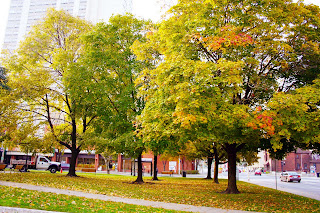
In the beautiful fall air, it is such a nice treat to go outside for a walk especially when the sun is shining. With worksheets in hand, my students and I went out for a scavenger hunt for specific numbers and colours of leaves. We walked to a park close to our school, shuffled through the leaves, selected the right colours and amounts, and headed back to the school to debrief about our findings. 

Outcomes: Listen to and follow instructions, read common nouns, read and understand descriptive adjectives, count items, orally describe items found.

The handout that we used was a bit challenging for my foundation level students. I would adapt it by making a simple chart with one column for the colour, and one column for the number of leaves wanted. 
Upon returning to the classroom, there was some debate as to exactly what colour some leaves were - was it really red, or was it more of an orange? Was it orange or really a yellow? While the answer does not really matter, the language that came out of this discussion was excellent. 

A great follow-up activity would be to do leaf rubbings (see up-coming posting). In the spring, you could a similar activity with colours of flowers or shapes of leaves (e.g. maple versus oak, etc).