Showing posts with label Fall. Show all posts

Tuesday, 15 December 2015

Apple Season

Apple season is one of my favourite seasons. There are so many learning activities that we can do with our learners with the theme of apples in mind.

1. Go to an apple farm to pick apples. This could involve trip planning by the learners, reading a farm map, and practising numeracy skills by weighing apples and calculating the prices.

2. Apple taste test. Bring in a few apples of several different varieties, and conduct a taste test with all the learners. Each learner can sample a slice or two of different varieties of apples paying attention to apple qualities such as the sweetness, tartness, and crispness. The class could then vote on their favourite by doing a survey and completing a tally chart. Learners could make graphs that display the class' preference for the "best" apple.


3. Make apple sauce with the class. Learners can peel, core, and chop the apples. Learners can take turns stirring the apples until the apples break down into the sauce. This could be another taste test and surveying opportunity by making different apple sauce recipes. You could add a pinch of cinnamon or a spoonful of sugar. My vote would certainly go to plain, unseasoned, and unsweetened apple sauce made from MacIntosh apples.


4. And of course, apple season would not be complete without drinking apple cider. See Beautiful Things - Apple Cider and Pumpkin Pie for an activity on describing apple cider with the five senses.

Saturday, 27 September 2014

Beautiful Things - Apple Cider and Pumpkin Pie

Apple season! My favourite time of year!

Seasonal foods may be new to some of the learners in your classes. 
Build in cultural experiences by bringing in culinary favourites for this time of year.
Be sure to ask about allergies, and be aware of dietary restrictions around lard as it is often in pie crusts.

Build from what the learners know, and expand vocabulary.

Use the five senses to describe pumpkin pie and apple cider.


Literacy Considerations
1. Change activities often. Do this kind of activity 20 minutes before break time to break up the day.
2. Begin with speaking. Have students orally describe and discuss words with a partner or a small group.
3. View learning as a social activity. Have learners enjoy the food and drink with a partner or small group.

Sunday, 30 December 2012

Guess the image


A special thanks to my creative colleague, B.B.,  for sharing this idea with us. She found it at http://www.greatgroupgames.com/zoom-in-game-thanksgiving.htm! She set up several of these sequential photos based on thematic words. Great for including horticulturally related items such as foods. All the food item vocabulary can be pre-taught with realia in class, and followed up by making some delicious recipes or sampling some apple cider.


Saturday, 17 December 2011

Mum Show


As summer air turns cool, mums start showing their colours in our gardens. Many houses in the neighbourhood around school have these little bursts of colour that last long into the fall months. Recognizing these flowers and seasonal importance of them can be a lot of fun.  Going for colour-hunt walks or taking a trip to the local Mum Show are two ways to celebrate the beauty of the changing seasons.

For the past few years my students and I have taken a local bus to visit the Mum Show at a greenhouse downtown. The Mum Show displays a variety of colours and species of mums - much more than the usual garden varieties we see around town. There is also a year-round tropical greenhouse. Students always bring their cameras and take many beautiful pictures of themselves, their friends and the flowers.

The tropical greenhouse houses many plants from countries my students are from. There are birds, geckos, fish and a turtle. The humidity in the room, the fresh air, and sound of the flowing water make for a relaxing and peaceful environment. This provides an opportunity to reconnect with the nature that is familiar.

My students use the time at the greenhouse to explore and experience it alone or with their peers. In my mind, it is such a great opportunity to experience a part of our city - a part that they may have never heard of or seen before. The actual structured language aspect comes afterwards in class. This year, I also wandered alone through the greenhouses snapping shots such as the ones below to use as the language focus the following day in class.


With these photos we reviewed the names of the colours (red, yellow, pink, etc.) and put them in sentences such as, "I see red flowers", and so on. From there, we sequenced the photos in a wall pocket chart, wrote sentences, matched the sentences and copied them onto small sentence strips. Students then created books for this story. 


Outcomes: name colours, sequence pictures from top to bottom and left to right, read words, copy words from a distance, listen to and follow instructions.


Thursday, 24 November 2011

Leaf Rubbings


What would the fall be without making leaf rubbings? I have done this on my own and with my students for many years. I have a pretty good stash of leaves collected that I reuse, but I am finding that over time they dry out and get brittle. I will have to replace them next year - maybe we'll have to go on a leaf walk!

This year, I finally realized how to overcome the struggle of the leaves moving under the paper while we colour on top. The solution??? Tape! Yes, tape the stem of the leaf (vein side up) to the paper. That way, the leaf will not slide around and the tape does not show. This makes for a much easier time in doing the leaf rubbing and you will have one solid line for the edges.

I encourage my students to be creative in the colours they choose. They do not need to stay with the tried and true fall colours of red, yellow, orange and brown. Many beautiful leaves were made with blues and purples too.

Outcomes: listen to and follow instructions, name colours, cut out shapes using scissors.

When we each finished 3-4 leaves, we cut them out and taped them up on the walls around the classroom. This adds a great fall feel to the room, as well as some colour, and amazing student work!
Monday, 21 November 2011

Leaf Walk


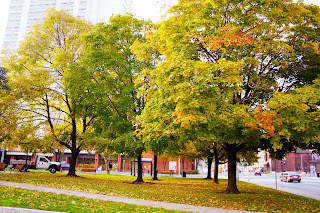
In the beautiful fall air, it is such a nice treat to go outside for a walk especially when the sun is shining. With worksheets in hand, my students and I went out for a scavenger hunt for specific numbers and colours of leaves. We walked to a park close to our school, shuffled through the leaves, selected the right colours and amounts, and headed back to the school to debrief about our findings. 

Outcomes: Listen to and follow instructions, read common nouns, read and understand descriptive adjectives, count items, orally describe items found.

The handout that we used was a bit challenging for my foundation level students. I would adapt it by making a simple chart with one column for the colour, and one column for the number of leaves wanted. 
Upon returning to the classroom, there was some debate as to exactly what colour some leaves were - was it really red, or was it more of an orange? Was it orange or really a yellow? While the answer does not really matter, the language that came out of this discussion was excellent. 

A great follow-up activity would be to do leaf rubbings (see up-coming posting). In the spring, you could a similar activity with colours of flowers or shapes of leaves (e.g. maple versus oak, etc).

Birdfeeders


As the temperatures drop and my students learn language for describing the weather, I wanted to do an activity that builds cultural knowledge and interest of the changing seasons. Growing up, my father always had the bird-feeder full and birds visited all winter long. Now that I have my own house, I have also taken up this seasonal activity with my own family. We love watching the birds and squirrels and trying to identify what species they are. 

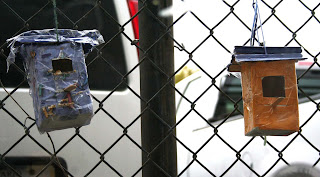
Inspired by this link, I opted for 500 mL milk cartons, colourful paper, popsicle sticks, and non-toxic paint. To water-proof the bird-feeders somewhat we covered them in packing tape. We used popsicle sticks for the perch as well. They have held up quite well over the past few weeks.

Before we started making this project, I explained to my students that the snow is coming and covers up food available to the birds to eat. It is good to provide the birds with healthy food to help them through the snowy winter. We looked at pictures of local birds and discussed the ones that the students had already seen in our area. I am planning on printing pictures of the birds and labelling them once birds actually show up to eat! This will continue developing their vocabulary. 

Outcomes: listen to and follow instructions, review and talk about colours, develop fine motor skills used in cutting, taping and gluing. 

After we constructed these feeders, we walked along-side our building and hung them on the chain-link fence outside our classroom window. This was quite a funny experience as we stopped at all the windows and waved at all the students in their classes along the way.

My students really enjoyed the process of making these bird-feeders. For some students, it was the first time they had used the tools required (i.e. scissors, glue, tape). Unfortunately, we have not had any visitors yet! However, the snow is coming and we are ready for them!