Showing posts with label CLB 5. Show all posts

Tuesday, 15 December 2015

Apple Season

Apple season is one of my favourite seasons. There are so many learning activities that we can do with our learners with the theme of apples in mind.

1. Go to an apple farm to pick apples. This could involve trip planning by the learners, reading a farm map, and practising numeracy skills by weighing apples and calculating the prices.

2. Apple taste test. Bring in a few apples of several different varieties, and conduct a taste test with all the learners. Each learner can sample a slice or two of different varieties of apples paying attention to apple qualities such as the sweetness, tartness, and crispness. The class could then vote on their favourite by doing a survey and completing a tally chart. Learners could make graphs that display the class' preference for the "best" apple.


3. Make apple sauce with the class. Learners can peel, core, and chop the apples. Learners can take turns stirring the apples until the apples break down into the sauce. This could be another taste test and surveying opportunity by making different apple sauce recipes. You could add a pinch of cinnamon or a spoonful of sugar. My vote would certainly go to plain, unseasoned, and unsweetened apple sauce made from MacIntosh apples.


4. And of course, apple season would not be complete without drinking apple cider. See Beautiful Things - Apple Cider and Pumpkin Pie for an activity on describing apple cider with the five senses.

Friday, 10 October 2014

ESL Week

ESL Week is a time to acknowledge dedicated ESL professionals and the hard work of ESL learners within our communities. There are endless ways to celebrate the work, energy, and dedication of all the stakeholders involved in adult ESL education.

Some ideas are:
- enter ESL Week contests (usually entries are submitted in early summer)
- host a writing contest at your school
- host an open house at your school and include cultural displays, international cooking, and activities
- host a potluck with your students
- invite and support students to do group presentations about experiences learning English
- share international recipes and publish a small cookbook (or publish on a class blog)
- invite coordinators to present teachers with a small token of appreciation (e.g., a card with a small treat)
- have students write thank you cards to coordinators and other staff


Check out TESL Ontario's web page: http://www.teslontario.net/esl-week
See the winning entries for this year's creativity contest. Get inspired to celebrate!

What are you doing to celebrate ESL Week with your classes? Post your ideas here!

Sunday, 13 July 2014

Outdoor Things to Do in the Summer

When schools are out in the summer, individuals and families often seek fun things to do. Outdoor activities may differ in different parts of the world. What do boys and girls usually do in the summer? What do adults do? One idea is to make a big class list and check off who has done what, and who will do what.

This Hamilton Conservation Authority Facebook link has a list of some ideas: https://www.facebook.com/HamiltonConservation/photos/a.111847857651.118338.7446247651/10152650367427652/?type=1&theater .

If you are teaching during the summer, you could try out some of these activities in school or on a field trip. You could tally up who has done the most things.


I have done 33 things on this list. How about you?

Themes: Canadian Culture, Leisure, Health and Safety
Grammar: Imperatives, cardinal and ordinal numbers, go / try + gerund

Reminder: Start with oral language first. This kind of language development could also be really fun if incorporating TPR (Total Physical Response).

Have fun!

Tuesday, 27 May 2014

"Eat your Weedies!"

Edible weeds in your neighbourhood? Why not learn about them!

With a teacher experienced in identifying edible weeds, several activities are possible across the levels.

A good resource book like this one can be helpful.  You could use it for your own information or adapt it for higher level learners.


You could
1. Talk about learners' own experiences foraging for and growing food. Do TPR to connect actions and vocabulary. See this link for some ideas for Phase I learners on using TPR and song for learning new vocabulary: https://www.youtube.com/watch?v=MJuOR9jTpV4

2. Talk about foraging in Canada - do people do it? Where? Why? What times of year?

3. Collect some edible leaves and flowers and have your students take photos of them, or trace / draw them.

4. Compare shapes, sizes and colours of leaves and flowers.

5. Take your class on a walk around the block to pick your own salad. Follow or make a map while you are at it!

6. Sample all the edibles and describe the taste, texture, and smell.

7. Have a local guest speaker come to class and talk about edible weeds.

8. Read a flyer (adapted as necessary) about a course on this topic: http://haltonenvironment.net/?tribe_events=eat-your-weedies-2

9. Find and follow some recipes using edible weeds. Write your own recipe.

10. Read and discuss issues around excessive foraging / harvesting (adapted as necessary): http://www.thespec.com/opinion-story/4034957-foraging-is-fine-but-not-on-rbg-property/


 Garlic Mustard 


Wood Sorrel (has yellow flowers) - Check out the warnings before you eat this.


Be careful, though! If you cover this topic with your learners, be sure you are providing all the correct and relevant information. Some edible plants may have look alike plants that are poisonous.


Monday, 31 March 2014

Winter Salad

Winter time can be a difficult time to find good quality and cheap fresh fruits and vegetables. In my class a few weeks ago, we had some visitors from a local "eat healthy" group demonstrate how to make a delicious salad with us. They brought all the ingredients, and we provided the bowls, forks, and appetites :)

For most guest speakers that come into my classes, I  encourage them to use simplified language and make the presentation very visual and experiential. Following this recipe was a great opportunity to build on these learning styles. We adapted the recipe based on what ingredients we had. This concept was a bit freeing for my learners and they began brainstorming ideas to make the recipe their own.


Our guest speakers brought this recipe. I do not know the source.

Some ingredients:


Great cooking vocabulary!

 Chop

 Slice

Toss

We sat and enjoyed this delicious and nutritious salad together. It was a social event and we talked about the textures, the tastes, and recipe adaptations.

Our final item: compost! In our city we are lucky to have a great municipal composting program. This all got pitched into the "green" bin.


Outcomes: Following instructions, describing personally relevant experiences, working with others, measurement, asking questions

Follow-up: Our community offers a "Good Food Box". This contains many fresh fruits and vegetables at a very low cost. It support local farmers and businesses. Practise reading the program flyer for details about dates, costs, items, and pick-up or delivery locations. Once the food box comes in, talk about the food and share other recipes.

In addition, you could precede or follow up this recipe with studying nutritional facts, reading food labels, and doing a class presentation on a nutrient or mineral.

Thursday, 16 January 2014

Needs Assessment Tool: Dotmocracy

Every two months, I like to assess what content and activities my students  want to stop, continue and start. 

One way I do this is a "dotmocracy".

My workplace has suggested a consistent yearly thematic sequence to cover. However, we can adjust this, extend it, and skip themes, etc., to meet the needs of our learners. For the topic dotmocracy, I told the students the themes were Travel and Transportation and Family, and if something else was important, we could add it. I love what they added! 

I gave each student five stickers. They had to choose the five most important things for them right now.


For the classroom activities dotmocracy, I started the list with activities that are regular weekly activities, and asked students to brainstorm what we do in class and other activities they would like to do. I gave each student the same number of stickers as items listed. I asked them to choose either “do” or “stop” for each one. Then, students put up their stickers during break.


From this, my students have essentially designed the curriculum for the next two months. I look at the most important items and our time-line and see what we can cover. We will do it again in two months. If something was missed and is very important, the students have the opportunity to express it and vote on it again. Also, students can see how many of their peers share their same opinion, needs and wants.

Monday, 30 December 2013

Winter Wishes

The end of the year celebration at school usually includes all students at all levels. The teachers tap into their creativity to meet the needs of the learners. This year, our students ranged from Literacy Foundation to CLB 6. To start off our morning, we designed an activity that included some student collaboration, speaking, fine motor skills, following instructions, and writing.

We started by having students put together a puzzle.


I designed the puzzle in Word, saved it in Adobe, and printed it as a poster. I enlarged it to about 375%, so it printed off into sixteen squares. The images I chose were not distinct enough, and we decided to add colours. Students used the colours to determine how the lines matched up. I gave them some clues such as that the puzzle was 4 x 4 squares. I also put up squares six and seven to get them started. Students of all levels participated in this.

This puzzle had the question for our next activity. First, each student expressed their own answers. Some students required a sentence starter, and others said a few sentences.

Then, we moved on to writing our sentences and decorating some winter-themed images.


Teachers and higher level students assisted lower level writers by writing down the learners' sentences or words. Students then copied their message onto the paper.


Happy new year to you all! I hope your winter wishes come true too!

Saturday, 29 June 2013

Pioneer Food Preservation

My class recently completed a unit on pioneer life. This unit included several readings, watching a film about Susanna Moodie and Catharine Parr Trail, going on a field trip to a pioneer village, and reading the graded Penguin reader of Anne of Green Gables.

Connecting the unit to horticulturally-related activities and topics was quite easy if you consider food and its preservation.

The following reading was challenging for my CLB 3, and 4 students among whom almost 40% have literacy needs. However, through a variety of activities, students can learn new vocabulary, practice and develop reading skills, and work collaboratively to share their own experiences. I have noted some activities and strategies that could be done with this reading.

Pre-Reading Strategies:

1. Activate background knowledge and build vocabulary
What are students' experiences with preserving food? When? Where? What? How? Who worked together to preserve it? Students can orally describe their own experiences.

2. Teach vocabulary
Select key vocabulary from the passage. In the reading below, I selected the words "pickled, salted, smoked, dried". Students will likely be able to relate some of the above experiences to these new words. The teacher could create a chart on the board and make a list of students' foods.

During Reading
1. Scan for vocabulary
To build scanning skills, students could use a coloured marker or pencil to underline or highlight the new vocabulary (e.g. "pickled, salted, smoked, dried").

2. Identify new vocabulary
It is important for students to be able to locate words that they do not understand. One strategy is for students to read quietly and underline or circle any new words for them. From this point, different options are possible for vocabulary development. Students could use dictionaries, guess the meaning based on the context, or ask a classmate or teacher.

3. Read Aloud
To practice pronunciation, word stress, and rhythm, students can read the story aloud to a classmate or the whole class. 


After Reading

1.  Review Vocabulary and Build Categorization Skills
Students could use a chart like the one that follows to review the key vocabulary, scan the text for details, and use a chart. This chart reinforces the one used at the beginning of the lesson that was based on student experience.  These two charts could be compared and contrasted.


2.Write About Their Own Expereiences
Students could select one food that they preserved and describe it in a few sentences or a paragraph (depending on student level). Students could also write down a recipe for preserving their selected food.

3. Hands-on Practice
Connecting to the above activity, the students could do a demonstration of their selected recipe, or the teacher could lead a lesson on following recipes. For example, the class could simply make strawberry freezer jam or pickled yellow beans. 

This kind of activity could be photographed for an LEA activity that could incorporate sequencing photos, writing a narrative and making a book or poster.

Wednesday, 19 June 2013

Bread and Butter

Little House on the Prairie, Anne of Green Gables.

I have observed a trend in my friends, and my on-line friends, to try to go back to a simpler time. Grow your own food, use cloth diapers, make bread from scratch. I admit that I enjoy being caught up in this trend as well.

At school, we just completed a unit on pioneer life. We studied this in preparation for a field trip to a local pioneer village.


As a follow up to the trip, we made two recipes: handmade butter and Irish soda bread.


If you use these two recipes, make the butter first. That way you can use the buttermilk and the butter in the bread recipe.

The Butter


Students enjoyed making the butter, and noting three different steps of turning whipping cream into butter. First, it was all liquid. Second, it was all solid. Third, it was half liquid and half solid: the buttermilk and the butter.


The Bread

The first step, if you are not using buttermilk, is to mix milk and vinegar. I asked the students to predict what would happen. Some ideas were that they would bubble, separate, and have no change.


Students took turns reading out the steps, measuring, adding, and mixing in the ingredients.
We had the extra challenge of doubling the recipe to make two loaves of bread. This was great numeracy practice!


 And finally ... the soda bread! If you haven't tasted soda bread before, it does taste like the baking soda / salt. One person spit it out, but the others enjoyed it.


We especially enjoyed it with the handmade butter!


Other activities: Start the unit with a KWL chart, read short stories about different aspects of pioneer life, read Penguin Reader level 3 of Anne of Green Gables using the great activities provided in the book to build a variety of reading strategies, and go on a field trip to pioneer village.

Wednesday, 17 April 2013

Hug a Tree! or Just Paint One for Earth Day!

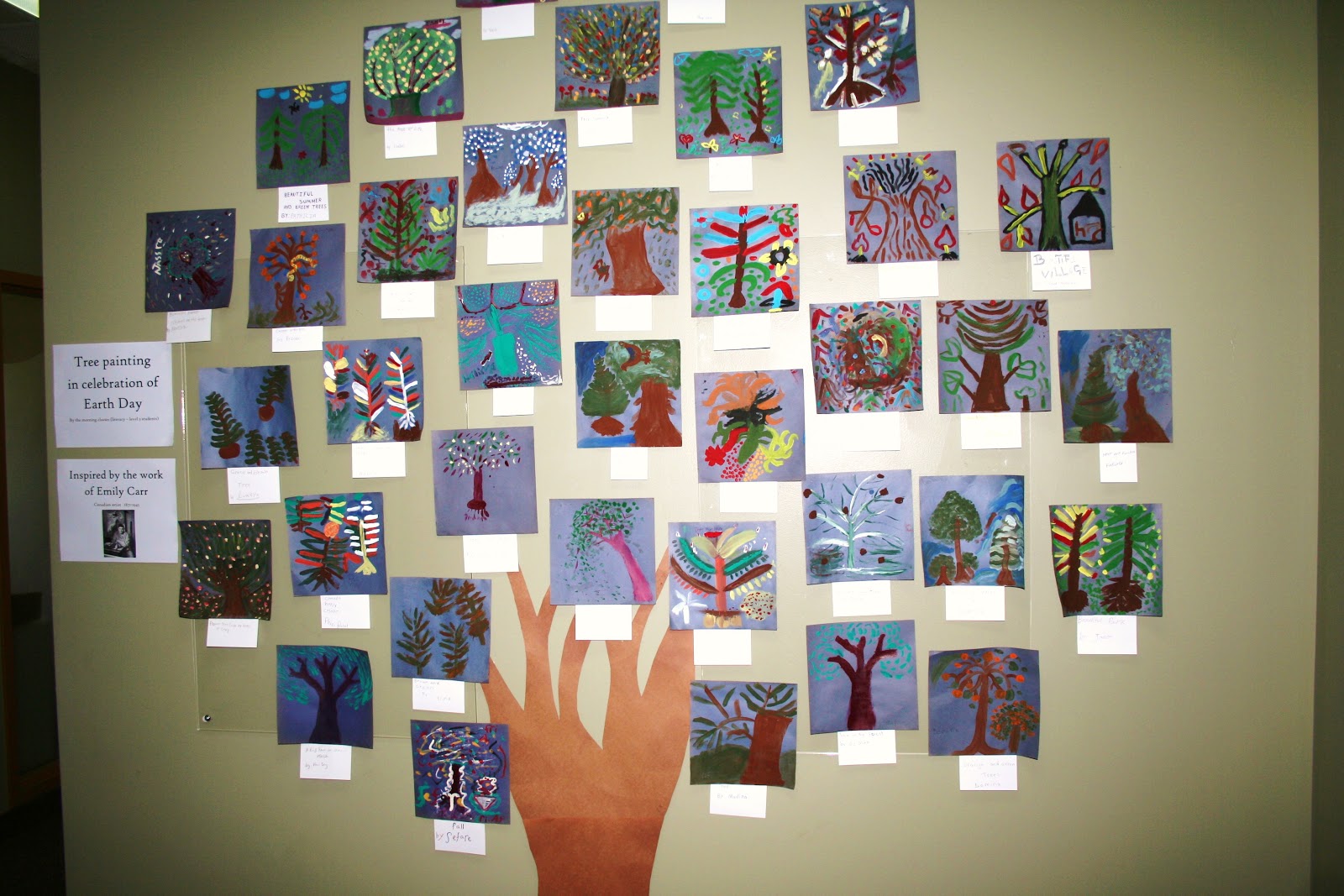
Concentration and creativity joined hands this Earth Day as students tried their hand at painting trees inspired by the late Emily Carr. My peer, B.B., guided the learners through Emily Carr images and noted how the painted lines showed movement. She found the idea for this project here: http://www.kinderart.com/arthistory/emilycarr.shtml.

The learners did 'air writing' of the movement, just tracing the shapes and lines in the air. Then the students got to it.


What really amazed me were the different interpretations of what a tree is.


 We then made a tree of all the trees.


It was interesting to see how people from different areas of world painted different styles of trees. The 'tree' in their mind was certainly not from the same corpus as Emily Carr's! What beautiful designs!

Amazingly, at our local art gallery an Emily Carr exhibit was showing at this time. This show was also featured in the local newspaper. A few teachers and a few students ventured out after school hours (during the free hours at the gallery) to visit the exhibit and experience Carr's art work in a new environment.  

Two of my colleagues, B.B. and A.B., entered this project into the TESL Ontario ESL Week Contest and won first place in the Photo/Collage Category! Here is a link to their outstanding work: http://www.teslontario.net/sites/default/files/webform/eslweek_instructors/Immigrant%20Women%27s%20Centre.jpg

Follow up activities can be found here:
Best of the Reader: Aboriginal People (graded stories of adults): http://www.bestofthereader.ca/Ebooks/Canada%27s_Aboriginal_People.pdf
Vancouver Art Gallery Educational Resources (may need to be adapted): http://www.museevirtuel-virtualmuseum.ca/sgc-cms/expositions-exhibitions/emily_carr/en/index.php 

Wednesday, 23 January 2013

Let it Snow! Let it Snow! Let it Snow!


Make your own snowflakes using templates!


Great for practice following directions, folding paper accurately, using scissors, and being creative!


Great for multilevel groups.


There were a few originals among the templates. Can you spot them?

Sunday, 30 December 2012

Cranberry Sauce


Although this is a seasonal dish, I had never made cranberry sauce in my life before. And, neither had my students. For most of them, they had not seen or tasted a cranberry before. We made this sauce from a recipe from the LINC 4 Activities: http://www.moresettlement.org/LINC1-4/LINC4/LINC_4_Classroom_Activities.pdf page 477 Cranberries, A North American Superfruit. 

To sample the sauce, I brought in some halal cheese (no rennet or pepsin) and some crackers. 

As we went through all the steps in the recipe, we described everything using the five senses. This included sampling a raw cranberry and a teaspoon full of pure maple syrup. Yum, yum! This builds concrete experience with the foods that many Canadians take for granted. It was also quite lovely to have this time out of the regular classroom and just to chat while each step was being completed. I will certainly try to do some more recipes in my class in the future. 

Outcomes: reads and understands short instructions, read and understand formatted texts, measure ingredients accurately, give simple descriptions of simple objects